|
“… a change in time is enough to re-create the world and ourselves.” – Marcel Proust  In Absolutely Fabulous, Paul Litherland playfully constructs stereotypical gender identities in himself, only to deconstruct them and raise his viewers’ awareness of cultural biases. The ten works that constitute this series evolved from a 1993 performance, Souvenirs. 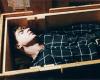 Wearing a tight, hot-pink jersey-knit dress with a scoop neckline that reveals a thick pelt of chest hair, photographer Paul Litherland poses coyly for the viewer in a sky-blue-lit studio for half of his self-portrait series, Absolutely Fabulous.1  Self-possessed women of all shapes, sizes, and ages, each fills the frame with intense looks, confidence, sex appeal, and power as she looks head-on into the camera’s lens and past, to the viewer. Compellingly seductive, these subjects pose for themselves and for the camera with a confronting gaze that is just as powerful.
Also see the artist's portfolio
Whether you like to admit it or not, we live in a society with an intense beauty-addiction problem that is directly tied to female representation and fantasy fulfilment. Our process of picking images apart to understand our relationship to them is becoming exhausting.  This article was originally published only in French. No translation is available. Voir aussi l'article reliéLes mises en scène épurées d’Olivier Christinat s’attachent à des portraits ou à des nus de jeunes femmes en une sorte de huis clos entre artiste et modèle qui outrepasseraient les limites de la pudeur.  This article was originally published only in French. No translation is available. – Read the Abstract Voir aussi le portfolio de l'artisteOn reste médusé face aux images d’Olivier Christinat. Une aura particulière émane de chacune d’elles à travers des mises en scène sobrement cadrées. Ses portraits et ses nus affichent une « lignée » de jeunes femmes endossant à ravir le rôle du modèle.  This article was originally published only in French. No translation is available. Voir aussi l'article reliéDans la plus récente production d’Ève K. Tremblay, L’Éducation sentimentale, Flaubert sert de prétexte à un «arrêt sur images» littéraires, cinématographiques, photographiques. Une série qui flirte avec l’art du désir. Désir de mettre en scène des sujets, à peine sortis de l’adolescence, évoluant dans ces lieux interdits, étouffants, anonymes que peuvent représenter les collèges privés.  This article was originally published only in French. No translation is available. – Read the Summary Voir aussi le portfolio de l'artisteSait-on vraiment ce que l’on cherche ? Qu’appelle-t-on l’identité ? Dans notre sac à malices, on en dissimule de ces masques commodes ou gênants. Et le rapport au monde, qu’en est-il ? Tout ceci demeure bien obscur.  This article was originally published only in French. No translation is available. – Read the Summary Dans le vocabulaire psychologique, l’affection désigne tout état de la sensibilité, toute condition psychique accompagnée de plaisir et de déplaisir. Du point de vue affectif, la sensibilité est cette faculté de sentir, éprouver des sensations, des sentiments, des émotions et des passions.  This article was originally published only in French. No translation is available. – Read the Summary « La frustration aurait pour figure la Présence (je vois chaque jour l’autre, et pourtant je n’en suis pas comblé : l’objet est là, réellement, mais il continue à me manquer, imaginairement)... L’absence est la figure de la privation; tout à la fois, je désire et j’ai besoin. Le désir s’écrase sur le besoin : c’est là le fait obsédant du sentiment amoureux. » Roland Barthes1
 There are girls and women who don’t want to believe everything that is said about them, or they would have to dismantle all the legends! This ontological need leads to an often terrifying plunge into the unconscious – the path Diana Thorneycroft takes in her search for her identity.  There are girls and women who don’t want to believe everything that is said about them, or they would have to dismantle all the legends! This ontological need leads to an often terrifying plunge into the unconscious – the path Diana Thorneycroft takes in her search for her identity.  Paul Lowry's work, from Photographs from the Grand Academy of Lagado (1989-90) through Copulation Studies (1993) to Man Figure (1995), has been inspired by various sources.
 She answered his request with the usual string of excuses. It was too late. He had asked her too late. Why had he not asked her earlier? She was too tired. She wanted to recite the rosary to the radio at seven. It was her way of teasing the child. |
|
|
|

Ciel Variable


- CD-DVD
- Social cause
- Group
- Catalogue
- Digital treatment
- Environment
- Work
- Nude
- Territory
- Vision
- Non representational
- Daily life
- Light-Shadow
- Tourism
- Historic
- Portrait
- Rural
- Collection
- Stillness-Movement
- Networks
- Identity
- Reproduction
- Documentary
- Garden
- Private-public
- Technology
- Industry
- Magazine
- Politic
- Narration
- Performance
- Memory
- Inhabit
- Emotions
- Mise en scene
- Film-video
- Architecture
- Landscape
- Family
- Interactivity
- Publicity
- Book
- Book
- Printing and publishing
- Installation
- Sexuality
- Institution
- Globalisation
- Mater
- Still life
- Photomontage
- Old photographic process
- Self
- Nature
- History
- Public Art
- City
- Presence-Absence
- Thematic
- Solo
The content of this site and the works reproduced within it (photographs and texts) are protected under the Copyright Act. It is therefore forbidden to reproduce, download or otherwise use texts and images found on this Internet site without the explicit and written consent of their authors and copyright owners.
